Petty Knife vs Santoku: Differences, Uses, and When to Choose Each
The term “petty knife” comes from the French petit couteau, meaning “small knife.” Despite its compact size, the petty knife is remarkably versatile and plays an essential role in Japanese cuisine.
While the Santoku is known as an all-purpose knife, the petty knife excels in precise, delicate tasks—such as peeling, decorative cutting, and intricate fruit work.
In this article, we explore the uses of a petty knife, how it differs from a Santoku, and when to choose each. We will also introduce JIKKO’s range of petty knives suited for both professional and home kitchens.
Take a Look at JIKKO’s Petty Knives
The Basics and Uses/Features of Petty Knives
In Japan, a petty knife is sometimes called a fruit knife. While the “petty knife” and “fruit knife” are often confused with each other, there are clear differences between them. So, to make it clear, let us explain the characteristics of a petty knife.
For instance, while the petty knife requires sharpness, the fruit knife is often placed on the dining table in a case or holder to use on the spot.
What is a Petty Knife? Uses, Features, and Differences from Fruit Knives
A petty knife typically refers to a small kitchen knife with blade length of approximately 120 to 180 mm in size. The term originated from the French word “petit,” meaning “small”or “cute,” and is characterized by its convenient size that is suited for home use. The knife is sometimes described as “small santoku knife” or “small Gyuto knife” by some.
The petty knife is quite useful when applied for intricate tasks like peeling fruit skins, decorative cutting, and prepping small fish, that is difficult to do with larger knives, and is favored by professional chefs to use, for both Japanese and Western cuisines. In particular, Japanese cuisine chefs often choose the petty knife for tasks that demand precise knife skills; you could say that a petty knife is a tool that supports the chef’s techniques by “delicacy” that it can apply.
On the other hand, fruit knives are often not as sharp as petty knives, since safety at the dining table is more prioritized. The fruit knives are more like a casual knife used by everyone in the home.
At JIKKO, we also offer smaller “paring” knives with blade lengths of approximately 80 to 90mm in size. With its short blades, paring knives are made so it is easy to handle when cutting ingredients held in the hands, and is suited for delicate tasks like peeling fruit skins, decorative cutting, and prepping small fish that are difficult to do with larger knives. The paring knives are also often used by professional chefs of both Japanese and Western cuisines as well.
Guidelines on Sizes and Blade Types (Double-Edged / Single-Edged)
The standard blade length for petty knives is about 135mm or 150mm in size, and sizes are chosen depending on the intended use and hand size. Shorter the blades, it is easier to handle, while longer blades let you manage slightly larger ingredients. Additionally, there are two blade shapes; “double-edged” and “single-edged”.
・ Double-edged (cutting edge on both sides of the blade): Is Symmetrical, making it easy to handle whether you are right or left-handed.
|
|
|


【HAKUHA】Petty Knife
HAKUHA VG10
The blade of the HAKUHA series is slightly thinner than other VG10 steel material products from JIKKO, and has lighter feel when cutting, and you can experience sharpness that is beyond expectations of VG10 steel material. The sensation is significant noticeable with the petty knife.
・ Single-edged (cutting edge on just one side of the blade): Has a sharper cutting edge, and is suited for slicing sashimi or decorative cutting when preparing Japanese cuisines.
|
|
|


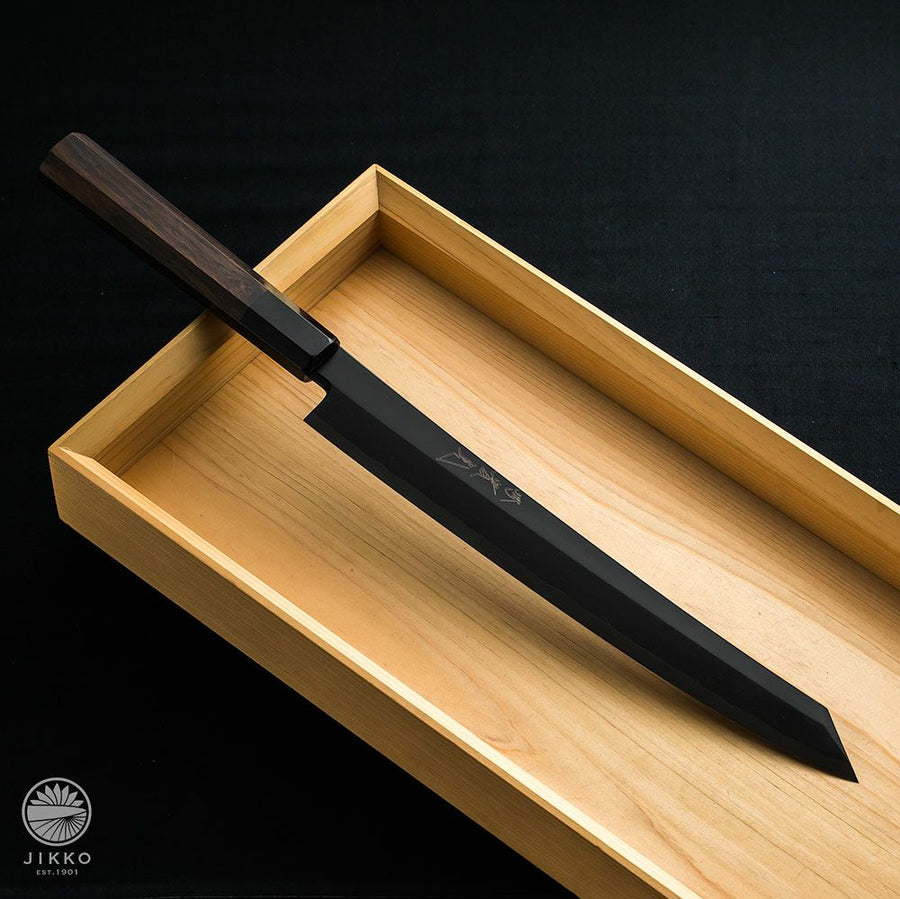
【Ginza GINSAN】 Single-edged Kiritsuke Petty knife
This is a GINSAN (Silver 3) steel material petty knife of JIKKO’s highly popular Ginza series, manufactured with our unique Sumizome coating technique. Unlike carbon steel, the black coating on stainless steel with Sumizome creates a matte finish, which gives it a notably subdued color. The blade tip with the notable kiritsuke customization, that all Ginza series’ knives have, makes it easier to work with. The GINSAN steel material makes it easier for people to sharpen the knife, and the knife has the shinogi line being a single-edged knife. One of the traits that GINSAN steel material has is that it is easy to sharpen, which makes this black coated knife easy to handle. You can enjoy the beauty of the knife, as well as the excellent work that you can perform with a single-edged knife.
When preparing for Japanese cuisine, it’s not uncommon to find professional chefs using single-edged knives. The usage of single-edged knives stems from a culture that values the beauty and precision of the cut sections; the versatility of the single-edged knives can expand in depth, depending on the chef’s skills and techniques.
Advantages and Disadvantages of Petty Knives
From here, we'll explain the advantages and the disadvantages of the petty knife in detail. If you find the advantages appealing to use, the petty knife might be more suitable option for you compared to the larger knife you might be using now.
⭐︎Advantages
・Compact and lightweight for easy handling.
・Easy for women or people with smaller hands to use with less fatigue.
・Less stress when cooking for a long time.
・Short blade length and sharp blade tip make peeling fruits and vegetable skins easier.
・Ideal for removing potato sprouts, avocado pits, and cutting/peeling small ingredients like cherry tomatoes.
・Performs well in smaller spaces.
・Suitable to cut ingredients on cutting boards, as well as ingredients held in hand.
・Easy to store. Since it’s smaller in size, the knife can fits into kitchen drawers or holders without taking up much space.
・The small blade makes it easier to wash and clean, and is hygienic.
⭐︎Disadvantages
・Not suitable for cutting larger ingredients, such as large chunks of meat or fish. → Use a Gyuto knife for larger ingredients and a Deba knife for filleting a fish.
・Not so multipurpose with its short blade length. → Use a santoku knife as a multipurpose knife.
・The heel of the blade is short, making it difficult to handle everything with just one knife.
・The blade doesn't rest well on the cutting board, so it makes it hard to perform “push cuts” or “slide cuts” that lets you cut ingredients at once.
・Most have thin, delicate blades, so if you try to cut bone-in meat, frozen foods, or other hard ingredients like pumpkin with force, it may lead to chip on the blade.
・Not suitable for shredding or mincing ingredients.
In short, the petty knife is “more supplementary, yet essential knife” to have. Unlike the multipurpose knives like santoku knives, its versatility widely differs depending on the task you want to perform.
And clearer the intention of what you want to do, the petty knife can guide you through the task with best performance.
Let us explain with some practical examples from the next section.
Uses and Benefits of Petty Knives in Japanese Cuisines: Ideal knife for Delicate Works
In the world of Japanese cuisine, various knives are used, but among them, the petty knife is a tool that is exceptionally versatile and convenient. Its compact size and sharp cutting blade are indispensable for performing precise and detailed work.
Why it’s Suited for Decorative Cutting and Delicate Tasks

White Carbon #2 Petty knife
This petty knife is crafted with white carbon #2 steel material. This carbon steel knife is indeed easier to rust compared to knives with stainless steel blades, but its sharpness is extraordinary, and can perform outstandingly when doing delicate tasks. The visual beauty and expression of the seasons greatly influence the dish's value in Japanese cuisines. Therefore, intricate knife work such as carving carrots into plum flower shape, cutting cucumbers into zigzag shape, and carving lotus roots into flower shape, is often performed.
The petty knife offers significant advantages over larger kitchen knives, which lets you perform such delicate tasks precisely and safely. The single-edged petty knives can especially perform well in such situations, since it is easier to control the blade and cut smoothly into the ingredients in intended angles, to greatly improve the quality of the decorative cutting.

The petty knife is also often used to prepare Japanese sweets as well. The petty knife is utilized for delicate tasks such as NERIKIRI cuts of Japanese sweets.
Peeling Skins and Preparing Fruits and Vegetables
In Japanese cuisines, many ingredients with skins like yuzu, kabosu, apples, daikon radish, and carrots that require peeling are often used. While the petty knife is light and easy to handle like the fruit knife, it also has sharpness like that of a Japanese style knife, so it is suited to peel the skin uniformly thin, and remove sprouts and buds from the ingredients.

【Kappa SG2】 Japanese style Petty knife
Three-layered petty knife with Powdered High-speed steel SG2 as the core steel material. The handle is “pistol grip shaped” designed wooden material imbued with dye, and the patterns on the handle differ depending on tree rings and wood knots. The blade is gorgeous with beautiful and shiny Damascus patterns, and the luxurious feel is just extraordinary. The curve on the handle lets you place your pinky smoothly, and this shape is designed so it is easy to handle. Every detail of this knife is carefully calculated and crafted with care.
This knife is useful for handling small ingredients, and lets you easily perform tasks like removing potato sprouts, thinly slicing ginger or garlic, and chopping green onions. It also comes in handy to cut fruit or slice cheese and ham on the dining table as well.
Ease of Use and Maneuverability at small spaces
In some commercial kitchen spaces or homes with smaller kitchens, it may be difficult to use even standard santoku knives. But since petty knives are shorter and lighter, it can be used with ease even on narrow cutting boards or long, narrow plates, and lets you perform safely even if the ingredients are a little slippery. The small knife is exceptionally useful when preparing for single dishes and Bento, as well as final adjustments when preparing dishes that require delicate work that need “unnoticeable yet crucial moments” at times. It is also easy to handle the knife close to your hand in a safe manner.
For instance, tasks like peeling apple skins, cracking crab shells, or chopping garnishes finely for dishes can be performed more easily with a petty knife than with a santoku knife. It is especially easy to handle when mincing green onions or garlic chives, since the shorter blades allows better visibility of where you’re cutting, and some feel that it is safer to perform with petty knives in such situations. Thus, petty knives function as “a tool that is like an extension of your hands” in Japanese cuisines.
Many skilled professional chefs use these traits, and have dedicated their skills into intricate cutting and preparations.
▶︎Take a look at JIKKO’s list of Petty knives
Choosing Between a Santoku Knife and a Petty Knife / How to Choose and Recommended Uses
The petty knife and santoku knife are more like “complementary tools” rather than “separately used tools”.
By comparing their respective strengths, you can use the knives at the light situations in respective manners:
Quick Reference Guide when Using Santoku Knives and Petty Knives
|
Cooking Methods/Preparations |
When a Santoku knife is appropriate |
When a Petty knife is appropriate |
|
Mincing Cabbage |
◎(the wide blade makes it easier to cut) |
△(the blade is shorter to work on) |
|
Peeling Fruit Skins |
△(slightly too big to do safely) |
◎(is smaller, so can cut more precisely ) |
|
Decorative cuts and Delicate works |
△(a little harder to do) |
◎(can control the knife more precisely ) |
|
Cutting Chicken meat |
◎(need some thickness) |
△(harder to cut thicker chunks ) |
|
Doing final adjustments on the plate |
△(slightly too big to use, harder to do smaller adjustments ) |
◎(the blade tip is thinner, so is easy to control) |
Characteristics and Strengths of the Santoku Knife

Non Oak Santoku&Petty knife set
VG10 stainless steel, Damascus & hammered pattern and Kiritsuke customization. The handle is made with white oak, that is taken from wood closer to the core, so the whiteness is enhanced, giving it a clean but stylish feel to it. The handle is octagonal shaped to give a non-slip grip.
After the war, Japanese dietary habits significantly changed. Thus, Japanese knife manufacturers paid attention to the Western-style multi-purpose knife known as the “gyuto”, and attempted to fuse it with useful traits of the traditional Japanese knives. The Santoku knife, a multi purpose knife meaning “knife that excels in three uses”, that can handle meat, fish, and vegetables, began to be widely used in households around Japan. The blade length is typically sized around 165–180mm, and the knife has a wide blade similar to the Nakiri knife, and has sharp blade tip like that of a Gyuto knife, which became the new, stable shaped knife. The santoku knife, being convenient in that it can cut various ingredients with just one knife, was rapidly adopted into Japanese households during the period of high economic growth.
In recent years, the knife has become widely known overseas as well as Japan's all-purpose kitchen knife“SANTOKU”.
Using Petty Knives for Japanese and Western Cuisines and Examples

This cutting work was done by using just one double-edged stainless steel petty knife. Persimmon was carved into a pumpkin lantern shape and filled with farfalle pasta. When the face was carved, the knife’s blade was inserted all the way in to carve out the inside. By holding the petty knife in one hand and the persimmon in the other, delicate work can be done with ease. By carving out the inside of the persimmon, the pasta was stuffed inside, and this dish gave a festive touch to Halloween parties.

This fruit plate was also created entirely with just one petty knife. You can easily work on decorative cuts with just one simple petty knife with a 12cm blade at your hand. Just have one petty knife with you, and you can enjoy fun fruit carving at home.

A Japanese cuisine dish made with intricate decorative cutting. Carving out the inside of small vegetables, and placing cut leaves beautifully. Petty knives are used to perform such tasks when preparing Japanese cuisines. Rather than being “separately used tools,” the petty knife and santoku knife are used in a “complementary relationship”. As mentioned earlier, by using the petty knife to handle tasks that are difficult to do with a santoku knife, you can create dishes with professional-level presentation even at home.
Furthermore, since Japanese cuisine involves many steps that require precision, it can be difficult to complete all processes with just the Santoku knife. So for those who want to put more emphasis on the appearance of the dishes, we highly recommend carrying two knives to use.
Recommendations of Owning Two Knives, and Key Points when Purchasing

CK Santoku/Petty knife set
A hybrid knife with Blue carbon super core sandwiched with stainless steel. The blade length is 18cm, which makes it slightly larger than the regular Japanese style knife, and you can experience astonishing sharpness with this knife! This is a knife set that you can enjoy the full potential of the hand-forged knives, that is unique to JIKKO cutlery. This Santoku knife and petty knife set offers significant advantages when cooking, to professional chefs and for home use. By using the right knife for each task, you can improve efficiency, safety, and the finishing touch!
For instance, you can finish all the morning preparations with a petty knife. During the busy morning hours, you are often required to efficiently make bento for your lunch, as well as the breakfast. The petty knife will be a great help, since you can swiftly get the job done without using much space, and even lets you cut ingredients in your hands. And when evening comes around, you can take out your cutting board to cut larger ingredients to prepare for dinner, which many of you need to take more time to prepare. At that time, you can take out your santoku knife so you can prepare and get the work done.
Key points when purchasing:
・For petty knives, choose the blade length based on hand size and intended use (JIKKO offers petty knife with blade size 12cm, 15cm, and 18cm )
・For santoku knives, focus on the weight and the blade width that is easy to handle (We offer both santoku and petty knives for most series, allowing set purchases)
・Consider the steel material used, such as stainless steel or carbon steel (※Carbon steel is easier to sharpen and has excellent sharpness)
At JIKKO Cutlery, we offer a wide range of knives, from professional-grade petty knives to knives that are more suitable for beginners to use.
▶︎ Look at JIKKO’s Petty Knives
Small Yet Versatile: What makes Petty Knives Appealing, Especially for Japanese Cuisines
A petty knife is not just a “small kitchen knife”. It is an essential tool to have, especially your Japanese cuisines, which require you to do decorative cutting and peeling skins, that needs to be performed with delicate techniques, and can determine the quality of the final turnouts of the dish. The petty knife lets you do intricate procedures that are difficult to do with a santoku knife, and you can further expand your cooking experiences, and enhance your expression as a chef.
Additionally, the material you choose for the knife significantly impacts the usability. For instance, a carbon steel petty knife is easy to sharpen, and is perfect for decorative cutting and intricate performances with the sharp cutting edge it has. You can easily restore the cutting edge by sharpening, and the knife is favored by many professional Japanese cuisine chefs. Meanwhile, the carbon steel is easy to rust, so you need daily proper maintenance.
On the other hand, stainless steel petty knives are rust-resistant and easy to take care of, so it is easy to use for home and beginners. Being lightweight, you are less likely to get tired when using, and there are some stainless steel knives that are almost as sharp as the carbon steel knives. Thus, the steel material, the structure, and the blade shape can change the ease of use of the knife.
Have in mind about the differences with the santoku knife; why not choose a petty knife perfect for you, at JIKKO Cutlery?
▶ ︎At JIKKO Cutlery, we offer a wide selection of high-quality petty knives recognized by professional chefs. Please choose the perfect knife that matches your situation
[Look at JIKKO Cutlery's Petty Knives]