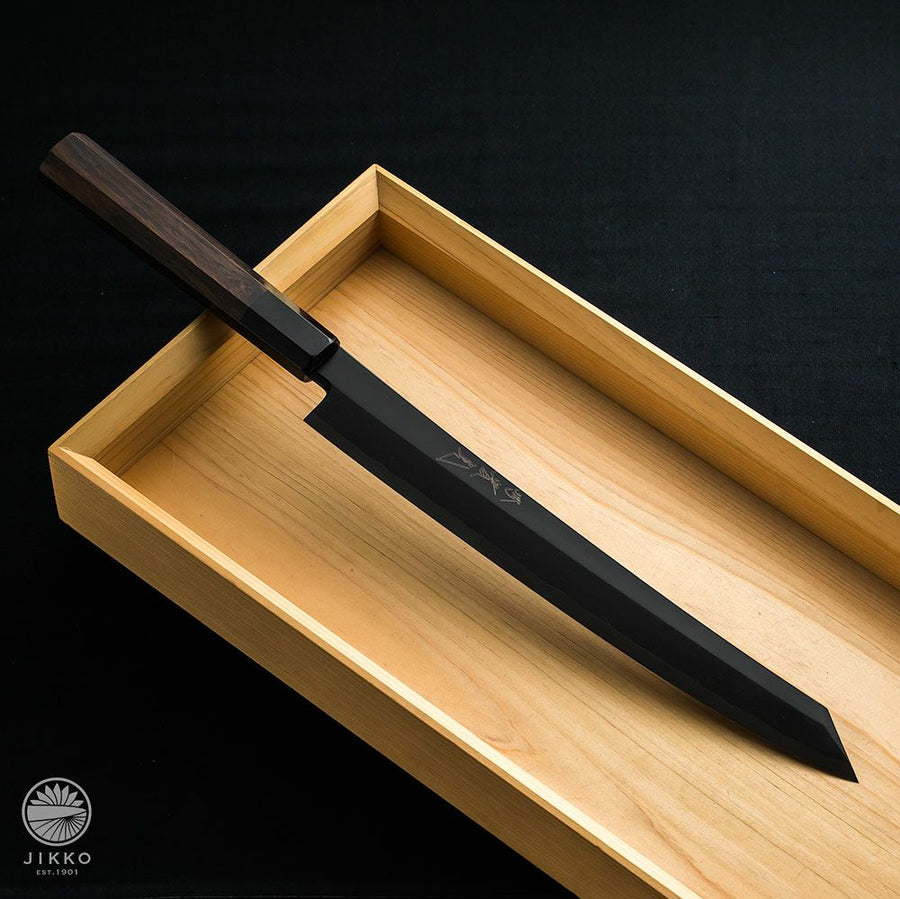
All-Stainless Steel Knives: Benefits, Maintenance, and How They Compare
A kitchen knife is one of the most important tools in everyday cooking. Among the many options available, all-stainless steel knives have become increasingly popular for their hygienic design, durability, and ease of maintenance.
Unlike traditional knives with separate handles, all-stainless steel knives feature a seamless one-piece construction that is easy to clean and less likely to trap food residue or moisture. Many models are also dishwasher safe, making them a practical choice for busy households, home cooks, and anyone looking for a low-maintenance kitchen knife.
In this guide, JIKKO CUTLERY—Japan's knife specialist with over 120 years of craftsmanship—explains the advantages and disadvantages of all-stainless steel knives, how they compare with other handle materials, and the best ways to care for them. Whether you're choosing your first kitchen knife or considering an upgrade, this guide will help you find the right option for your cooking style.
The reason why All-stainless steel knives are chosen for daily uses

All-stainless steel knives are one of the popular knife choices for daily household usage and cooking. Being a multipurpose knife that is ease to take care of, it’s a knife that we recommend for busy chefs in the home, and those living alone. The reason why we recommend these knives is because of reasons like “structural cleanliness”, “hygienic peace of mind”, and “advantage points over other material made knives”. From here, let us explain more deeply about each point.
Take a look at JIKKO’s All-stainless steel knives
The advantage of knife being made entirely of metal, with no joints
The traditional wooden or resin handled knives tend to have a slight gap or space between the joints of the knife and the handle. And when liquid or residues from ingredients goes into that gap, there are higher risks of bacteria breeding. And in locations like Japan that tends to be humid, molds and dark spots are more likely to occur.
On the other hand, since the all-stainless steel knives are an integrally formed product from the blade to the handle, there are no gaps in between, and is easy to clean and dry. It’s easy to shake off the water, and you can keep the surface clean just by wiping it with a cloth, making daily cooking more efficient.
The supreme characteristics of the all-stainless steel in terms of durability and hygiene
What is good about the stainless steel knives is that it’s a metal that is “rust resistant”, and has “corrosion-resistant properties. Being alloy metal with chromium, it can form oxide films in the air to prevent rust to grow.
Thanks to these traits, the stainless steel knives could be used safely for a long time, even in kitchens that are often exposed to water and acidic ingredients. This trait, you could say, is one of the biggest advantages of using a stainless steel knife.
Furthermore, wooden handles have concerns like deterioration due to water absorption and odor stains, but you don’t need to worry about all that with stainless steel knives. Being able to maintain the sanitary conditions just by simple washing and drying, is a big advantage for busy household chefs!
The advantages compared to other materials
|
Wooden handle |
Resin handle |
Stabilized wood handle (wooden handles with dye soaked in) |
Plywood handle |
|
|
|
|
|


The greatest strength when compared with wooden or composite material handle knives, is the “balance between ease of cleaning and durability”. While the wooden handled knives are easier to grasp and hold, since they do too well with so much liquid, frequent maintenance is needed. The resin handles are relatively easy to handle, but with long term use, it is more likely to crack, and get small scratches.
In contrast, all-stainless steel knives are durable, and you do not need to worry about handles cracking or deteriorating from liquid as much. On the other note, it does tend to be heavier, but that weight can lead to balance out the weight, and supports you cutting meat or vegetables in a smoother manner.

Since a knife is something that you use daily, the fact that it “can be used safely and cleanly for a long time” is one reason to choose and buy a knife. On that point, an all-stainless steel knife is trustworthy for home usage.
Strong against rust and is OK to just dry/Dishwasher safe
Another big reason that all-stainless steel knives are appreciated is the ease of maintenance. Cleaning after cooking is a daily task as well, so whether you can maintain cleanliness in a short amount of time, is a major point. From here, we will explain about maintenance points, dishwasher compatibility, and comparisons with other materials.
The ease and convenience of all-stainless steel handles
The traditional wooden handled knives need to have the liquid wiped off, and stored in locations without moisture after use, or else the handles could deteriorate. The resin handles have some water resistance, but long term usage could cause small scratches on the surface, and stains could occur from there.
On the contrary, since all-stainless steel knives are single piece, from blade to the handle, there are no gaps, and you can rinse away most of the residues just with running water. You can dry it easily as well, by just wiping the whole knife softly with a towel. Being able to cut the tiresome cleaning time is a big advantage for busy households.
Dishwasher safe or not, and points to note
Some may think that “since it’s all-stainless steel, there’s no problem using the dishwasher!”, it’s not always the case, and it just depends on the model. There are no problems if it is said that the knife is dishwasher safe, there are some models that could cause metal fatigue and blade chipping from high temperature drying.
Also, the blade tips could get damaged by it crashing into other cooking utensils inside the dishwasher, so it’s best to keep it secure in holders or some sort to be safe.
At JIKKO CUTLERY, we have all-stainless steel knives available in 2 types of steel materials. Please choose the material based on your use.

・Uses Damascus SG2 steel
・The finest quality of stainless steel! The layered Damascus patterns are just gorgeous!

RIN Santoku knife
VG10 stainless steel
The disadvantages compared to the wooden and composite material handles
Though the all-stainless steel knives stand out from other knives in terms of ease of maintenance, it doesn’t mean there are no disadvantages. For instance, being all-metal, the knife tends to be more slippery than others, especially when wet, so you may feel it’s more difficult to grasp with a wet hand. The wooden handles on the other hand are more hygroscopic, so it fits comfortably in your hand, making it easy to grasp; which some people favor more.
Also, since an all-stainless steel knife is a more solid piece of metal, it tends to have more weight than others. For those who need to cut and use for a longer time, it could be more tiresome to keep using the knife, compared to how light wooden handled knives are.
We will go into more details about the advantages and disadvantages in the table below.
Tips on re-sharpening to make your knife last longer
While the stainless steel knives are more resistant to rust, the stainless steel materials tends to feel harder to sharpen compared to carbon steel knives for many. To maintain the sharpness of the blade daily, simple maintenance using easy-to-use sharpeners (like water sharpeners) that you can use with ease is recommended. Particularly, those of you who use the dishwasher for your all-stainless steel knife or cut more solid ingredients often, the cutting edge can get dull after use, so we recommend simple sharpening once or twice every month to continuously use your knife safely.
Thus, though the all-stainless steel knives seem good to use for home use in terms of “ease of cleaning” and “dishwasher compatibility”, depending on how you use or treat the knife, there are both advantages and disadvantages for using them. But if you know the right methods to use and care for the knife, it’s a knife with a balance of cleanliness and longevity that can support your daily cooking experiences.
Comprehensive evaluations of the Advantages and Disadvantages of hygiene and ease of use
The all-stainless steel knives catches attention as a great home use knife in terms of hygienic and durability, but that doesn’t mean it is the best and perfect option for all. Here, with focus on the hygienic aspects of the knife, we will dive deeper into the usability and overall points of the all-stainless steel knives, including its disadvantages.
Structural design that makes it difficult for the bacteria to grow
The biggest advantage we would like to point out, is that since it’s all connected from the blade to the tip of the handle, “there won’t be any residues on joints of the knife”. With wooden or resin handle knives, there just will be tiny gaps and spaces between the blade and the handle, and liquid and ingredient residues tend to get in them. As a result, bacteria and molds are easier to infest, and cause hygiene risks.
On the contrary, all-stainless steel knives are easy to wash, and fast to dry, so bacteria are less likely to grow so fast. For those of you that often cut raw meat or fishes often, being hygienic will be a big reassuring factor.
Using precautions such as slipperiness and weight
But, as stated above, not everything about it will be positive. Since all-stainless steel knife handles are metallic, you may feel that it’s slippery when held with wet hands, as well as when you cut many oily ingredients with it. This is something you need to be careful of. There are all-stainless steel knives with handles that are customized so you can grip it better, it will feel different compared to wooden handles that “fits into the hands more naturally”.
And, since it’s all metal, the knife tends to have more weight compared to the wooden handled ones. The weight or the all-stainless steel knives leads to stability for shorter cooking experiences, but for longer usage and cutting larger amounts of ingredients, some may feel more burden on the wrist and hand. So for daily usage in the home, how you “deal with the weight” becomes an important factor.
Below is the summarization of the advantages and the disadvantages of the all-stainless steel knives:
Advantage and Disadvantage comparison table
|
Advantages |
Disadvantages |
|
Easy to keep clean since there are no joints between the blade and the handle |
Being metallic, could be slippery |
|
Is rust-resistant and has high durability |
Tends to be heavier and can get tiresome after long term use |
|
Easy to care of, and there are many dishwasher safe models |
Harder to sharpen compared to carbon steel knives |
|
Less likely to have liquid and remains to stay on the blade |
Might feel pretty cold to hold in winter |
Thus, there are great advantages in terms of hygiene and ease of cleaning, the weight and grip are something that’s not for everyone.
As you can see with the table above, there are pros and cons, so it is best for each person to consider all the factors, and figure out if the knife is something that suits your situation or not. We’re introduce to you some voices from our customers that have bought and used all-stainless steel knives:
Case 1: customer from overseas.
According to the customer, their “daughter gave birth to triplets and is just so busy. She is standing in the kitchen the whole day, and is cutting a tremendous amount of vegetables”.
They bought the NEVERSTAIN 2 knife for her. Since the use of dishwashers was common in their country, they wanted a dishwasher safe knife; they also wanted something that was somewhat durable, since their daughter sometimes has to stop cutting every now and then to care for the children.
The nice scale-like handle was really attractive as well, but they were more in for hygienic aspects and ease of use of the NEVERSTAIN 2 knife.

NEVERSTAIN 2 Santoku knife
Case 2: Another from a customer overseas.
A gentleman who “lives by himself, and often goes on international business trips. He can’t spend so much time cooking, but whenever his friends come over to visit, he wants a knife that anyone can use easily”.
We focused on the fact that many people will use the knife, so we recommend him RIN series santoku and petty knives. According to him, he has not used a petty knife back home, but he did like eating fruits, so once he learned that petty knives are a good option to use for the fruits, he decided to nut both. We were able to recommend specific knives after we heard what he was looking for.

RIN Santoku and Petty set
To choose a knife that best suited for your daily uses
A kitchen knife, that is the necessity for every day cooking, is not just a mere tool, but is something very important that supports our family tables. Having traits like “hygienic and can be used cleanly”, “easy to care of”, and “lasts for a long time”, all-stainless steel knives are a great help, especially for busy households.
Meanwhile, there are issues like slipperiness and the heaviness of the knife, which makes it not so almighty for everyone. Because of this, it is important to think about “the top priority you want to consider” for your situation.
⭐︎all-stainless steel knives if you care for hygiene and ease of cleaning
⭐︎wooden or combined material handles knives if you care for the lightness, or grip on the hand when you hold it
Like that, it is ideal if you could choose a knife based on your style of cooking.
At JIKKO CUTLERY, we have a wide selection of knives, including all-stainless steel knives that are suited for daily household usages.
We carry different sizes for NEVERSTAIN and RIN series, the all-stainless steel knives, to make your busy days more comfortable, with less stress and time, at JIKKO CUTLERY.
By choosing a knife that is hygienic and is easy to care for, it will definitely make your cooking experiences more efficient and safer. So let's search and choose a knife that is perfect for you!