SUSHI ROKUSHIKI: A Blade Through It All

Yuri’s trusted partner rests within easy reach.
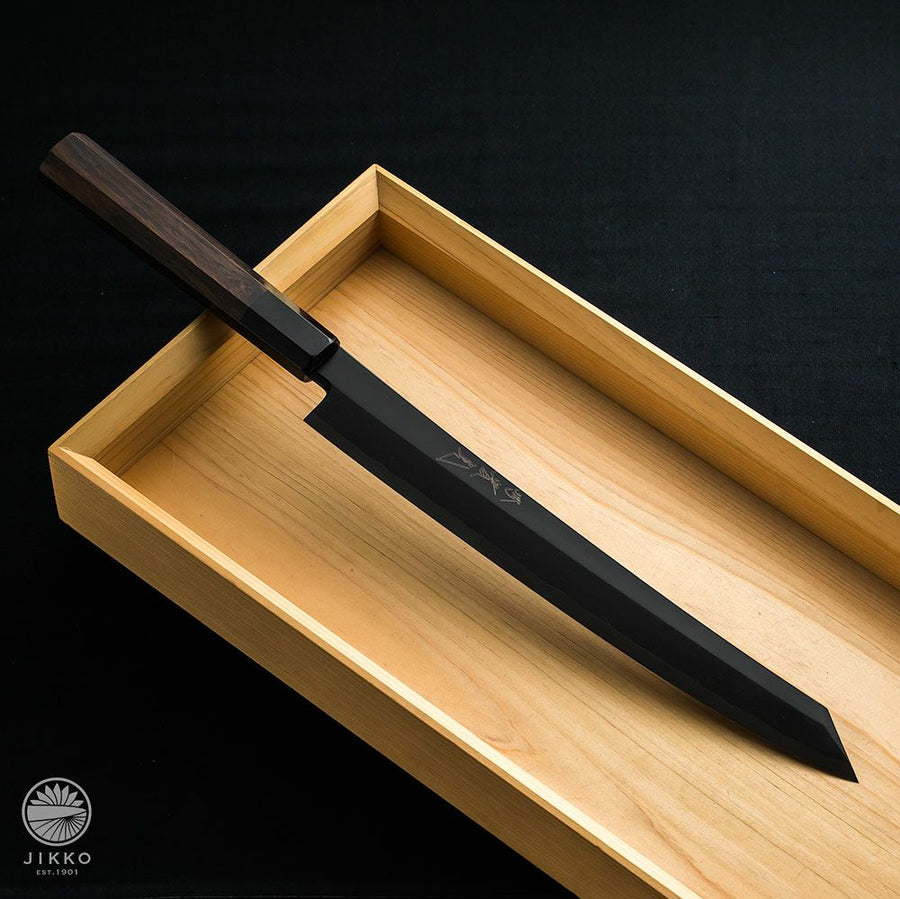
It is the JIKKO sashimi knife she turns to whenever she slices fish. Long and slender, it lies beside her on the immaculate counter, waiting quietly for its next moment of work.
Even from across the counter, it is clear how carefully the knife has been maintained. Its substantial ebony handle has gradually taken on a warm sepia tone with use, its once-smooth surface becoming easier to hold.
After every slice, Yuri carefully wipes the blade clean. The knife is indispensable to the sushi she creates. Together, the blade and her graceful hands give form to each piece.
“The blade glides through the fish so easily. I love the design, too—it looks at home wherever I place it.”
Yuri chooses her words with care.
Many of the pieces she serves are scored with fine incisions. These delicate cuts make the sushi easier to eat, allowing even guests who may hesitate to take an entire piece in one bite to enjoy it comfortably.This precise work is made possible by the partner at Yuri’s side.
“I don’t want to be a chef who simply prepares sushi. I want to share the culture and stories behind it with my guests.”
Almost everything that supports sushi is connected to Japanese tradition.Not only the knife, but also the rice, the sake, and the tableware each carry a culture and a story of their own.
Some of the dishes at Sushi Rokushiki have been repaired using kintsugi, the Japanese art of restoring broken ceramics with lacquer and gold. One glance is enough to see how deeply the restaurant’s owner cherishes them.
Their value lies not only in their beauty or function, but also in the memories they hold and the culture they carry forward. Yuri shares that same desire to preserve these stories and pass them on to the next generation.
Once, after tasting a sake that deeply impressed her, Yuri traveled to Fukushima just two days later to meet the people who made it.That impulse came from her curiosity and her love of sushi.She later brought the sake into the restaurant, placed it on the counter, and began recommending it to her guests.
Yuri does not simply wait for the right ingredients and tools to find her. She goes out and chooses them herself—each one a partner in the work she creates.
And she continues searching for new partners to bring into her world.

Hatsugatsuo—the season’s first bonito—presented in its purest form, marked with delicate incisions.
“It’s hatsugatsuo—the season’s first bonito.”
The vivid red flesh is scored with countless fine cuts.
It glistens beneath the light.
The piece is so plump and generous that it makes the bonito we usually see seem like an entirely different fish.
Perhaps this, too, is the result of Yuri and her trusted partner working as one.
Next: “The Final Curtain Call” — Yuri’s reflections on what it means to build a lasting life as a chef.