High-End Japanese Knives: Steel, Craftsmanship, and Choosing the Right One
True culinary mastery begins with exceptional tools. High-end Japanese knives are celebrated worldwide for their precision, beauty, and craftsmanship.
In this guide, we reveal the art behind these blades—from premium steels and forging techniques to selecting and caring for a lifetime knife.
Presented by JIKKO Cutlery, a Sakai-based specialist with over 100 years of heritage.
The Glamours of the High-End Japanese Knives that attracts global attention
Exceptional sharpness and cutting edge. The fusion of craftsmanship and tradition. Beauty that satisfies both design aesthetic and the desire to own.
Japan’s High-End knives is one of the tools with techniques and traditions condensed inside, that attracts global attention. A knife, is one of the finest tools that anyone can easily obtained within daily life. By simply changing a knife, you can enhance and add more colors to your life with even more delicious cuisines, and enjoy eating. Japan’s High-End knife is truly a “tool that is also a work of art”, that can provide happiness and joy, while improving your culinarily skills by using them.
Sakai forged knives, originating from gunsmiths and swordsmiths from ancient times.
There are several reasons why Sakai-made knives has gained worldwide attention today. For instance, alongside the sharp cutting edges that the craftsmen have passed on down, the modern yet beautiful designs enhances the glamours of the Japanese High-End knives even more. At JIKKO, we would like to offer our customers one-of-a-kind knives with exceptional cutting edge, as well as luxurious and beautifully designed appearance. By using exceptional tools that can provide delicious cuisines, you can add more beautiful colors to your life.

https://jikkocutlery.com/collections/ginza
Why Overseas Professional Chefs Also Favor Them
The reasons overseas professional chefs also favor Japanese knives, is the fact that the fusion of the practicality, beauty, and the cultural depth knife was made with. Let us introduce to you some of the voices from around the world.
☆Remarkable sharpness and cutting edges.
The “sharp blade” of Japanese knives can cut ingredients without damaging them at the cellular level, and preserve their flavors and textures. This is a crucial factor that significantly enhances the quality of cooking (Arab News, Web Japan).
☆You can choose the right knife for specific situations from the wide variety of knives
They have wide selection of knives that you can use for specific purposes, from Sashimi, Deba, Nakiri, etc. Professional chefs can drastically change the finish of a delicate dish by using different knives based on ingredients or purposes (inshokuten.com).
☆Outstanding Craftsmanship and the inherited Traditions
The Japanese knives, forged and crafted through relentless refinement and consistent quality control, are truly a “artwork of tools”. The knife manufactured from multi-steps of sharpening and craftsman's delicate techniques are something that can’t replicated elsewhere (KIREAJI).
☆Lightweight and well-balanced design
Japanese knives that are lightweight with well-balanced designs fits nicely in hands of the professional chefs that works for long hours, and can reduce their fatigue. The ease of use is one of the key reasons that I keep using them (chefs-edge.com).
A design that satisfies both beauty and the desire to own one. The beautiful appearance is one of the glamours of it. The well-designed High-end knives simply deepens your affections to cooking, and you can just be proud by owning this tool (For shopping knives online, choose Sakai’s JIKKO Cutlery, established in 1901, vogue.com).
The Differences Between Japanese and Western Knives and How to Choose One
|
|
|


|
Features |
Japanese Style Knife |
Western Style Knife |
|
Blade Structure |
Single edged, thin blades→ precise cutting can be done |
Double-edged, thick blades→ sturdy and easy to handle |
|
Material and Sharpening Characteristics |
Hard steel → lasts well but easy to chip |
Soft steel → durable but need constant sharpening |
|
Handle |
Light, wooden, can be exchanged→ agile maneuverability |
Heavyweight, emphasis on stability |
You need to choose the appropriate length and steel materials for both Japanese and Western style knives, depending on the purpose and their respective roles. There are few criteria that professional chefs consider when selecting a knife.
Blade Type Selection Based on Usage (example: Yanagiba=sashimi, Usuba=Vegetables, Gyuto=multipurpose)
Factors directly linked to usability is greatly valued, like
Comparing cutting resistance based on blade angle differences
Checking factors like single-edged/double-edged suitability on the dominant hands, and ease of sharpening
Blade Structure and Sharpening Angle
・Japanese style knife (single-edged/thin blade)
Most tends to be sharpened only on one side (“single-edged”), has beautiful cut surfaces, and has preciseness that lets you cut without crushing the food’s cut-sections. It is especially suited for sashimi and thin slicing.
・Western style knife (double-edged/thick blade)
Are “double-edged” that are sharpened on both sides of the blade, can easily apply well-balanced force when cutting, and is multipurpose so that it can handle wide variety of ingredients
Steel Material and How to Sharpen the Knife
・Japanese style knife
Generally made with hard steel, the Japanese style knives lasts longer, but can chip easily, so careful sharpening and handling are required. It is best if you could use at least 2 different whetstones with different grades, so that you can sharpen them to keep using the knives for 20, and 30 years. You can also bring it in to us, JIKKO Cutlery, for professional sharpening.
・Western style knife
Generally made with softer steel, the Western style knives are sturdy and easy to sharpen, but need more frequent care. If the knife is double-edged, you can use a simple knife sharpener for easy sharpening.
Handle and Balance
・Japanese style knife(Japanese handle)
The wooden, lightweight handle is balances slightly toward the blade, so agile maneuvers are possible to do. You can also exchange the handle, and keep using the same blade for a long time.
・Western style knife(Western handle)
Are usually made with metal or synthetic material, and the weight is balanced more toward the handle. The firm grip provides stability when handling, but the holder parts may be in the way when you sharpen your knife.
The Reliability of “Made in Japan” and the Depth behind Steel Material
Why does “Made in Japan” knives have such deep trust worldwide? Why are the steel materials used for the knives so good? Each steel materials that we’ll introduce below are all suited for Japan’s High-end knives to have. The “VG10” steel has high hardness level, and edge retention is excellent even after long term use, so is loved by many professional chefs. The “Powdered High-Speed Steel SG2” is resistant to wear and chipping, so you don’t need frequent maintenance.
And now, there are newly produced steel materials as well, and the “Made in Japan” knives just keeps on evolving. With the brand new steel material, “SPG STRIX”, joining the list of steel material used in Japan-made knives, there are even wider range of options for knives. The “Made in Japan” is recognized worldwide not just by country of origin; it is now a symbol of quality assurance to the world. And cities like Sakai and Seki that are major knife production area in Japan, has maintained world-class knife craftsmanship, with their blacksmith culture that have continued for centuries.
Understanding the Essence of High-End Japanese Knives Through Steel Material and Forging Techniques
When discussing about high-end knives, the “steel material” choice is an unavoidable topic. The blade performance is determined by the composition of the steel materials used, and its heat treatment. The key factors of choosing the steel materials, includes frequency of use, your maintenance method, and understanding of the blade’s hardness. Generally , if you enjoy sharpening, White Carbon steel is a great choice, while those who seeks the best sharpness should choose Blue Carbon steel, and VG10 is a good option if you want to have a knife that is easy to maintain.
Characteristics of Blue Carbon Steel, White Carbon Steel, and VG10, and how to choose
Blue Carbon steel (Blue Carbon #2, Blue Carbon Super)
A carbon steel that has achieved high hardness, high toughness, and excellent wear resistance by adding chromium and tungsten. The edge retention is excellent even after heavy professional use, and you do not need to re-sharpen the knives as often. The Blue Carbon super, in particular, are considered as the best steel material by many, and flowing cutting experiences are maintained for a long time. The blue carbon steel is the “invincible steel” that has high hardness and excellent wear resistance.
While the steel is prone to rust, and requires delicate care, the professionals who prioritize the “joy of cutting” favors this steel. What is particularly noteworthy is the selection of the steel and the precise quenching processes; the Blue carbon steel has high hardness and durability, and the edge retention is just overwhelming.
White Carbon steel (White Carbon steel#1, White Carbon steel#2)
The steel has high purity of carbon and iron, that makes straightforward quenching processes and fine edge reformations are made possible. The steel material is suited for delicate procedures and sashimi knives, and is a steel that craftsman’s sharpening techniques are optimized to its fullest potential.
The white carbon steel possess tenacious nature, and you can maintain extremely sharp cutting edge if sharpened properly, and the result is just noteworthy. When comparing it with other carbon steel, the white carbon steel has more straightforward properties, and delicate blade sharpening and shaping could be done. Since the white carbon steel enables you to obtain highly delicate blades, those who seeks knives for intricate cutting process favors the steel.
VG10
While it is a strain less steel that is rust-resistant, it also has excellent corrosion resistance, and the balance between hardness and durability is excellent. Has both high hardness (HRC 60+) and excellent cutting edge. The. Steel materials are especially favored by overseas customers that seeks for a knife that is more easy to maintain. It has features like great edge retention and ease of sharpening, and many professional chefs choose this steel as well. And the rust-resistance and the high hardness it has are highly acknowledged by overseas customers, since those traits are actually difficult to balance with other steel materials.
SG2 (Powdered High-speed steel)
A Stainless steel material with high hardness and excellent wear resistance, that maintains great edge retention. Manufactured using powder metallurgy technology, it yields precise and homogeneous steel material. Since this steel material has extremely high hardness, the sharpness lasts for quite a long time.
Structural Differences Between Honyaki and Warikomi knives
Structure of HONYAKI
Material: Each knife is made from a single piece of steel (carbon steel or stainless steel).
Manufacturing Method: Traditional Japanese style knife-manufacturing techniques. Every step is hand crafted by a skilled craftsman, from forging to quenching and tempering.
Features: No matter how much you sharpen, since the blade is made from a single steel material, the sharpness remains the same.
Precautions: Due to its high hardness, Honyaki knives are vulnerable to impact and twisting, and is prone to chipping. If rust-prone steel material was used to forge the blade, frequent maintenance is essential. The production of the Honyaki is extremely difficult, so the prices are set high.
Structure of WARIKOMI
Material: A three-layer structure; the core steel material (hard steel) is sandwiched between two layers of soft base metal (stainless steel or soft iron). Also known as “Awase” knife.
Manufacturing Method: The core steel material is only exposed on the cutting edge, while the sides are covered with soft base metal.
Features: Combines the sharpness of the core steel material with the toughness (resistance to chipping) with the soft base metal. The Warikomi knife is also available in a rust-resistant stainless steel core structure, so is popular by overseas customers.
Precautions: As you sharpen the knife, the core steel material will be thinner, so the sharpness, as well as the edge retention is lower compared to the Honyaki knife.
Evolution of the Sharpness Through Fusion of Traditional Forging Method and Modern Technology
Japanese knife manufacturing traces its origins to swordsmiths for samurai, over 400 years ago. In major knife production areas like Sakai and Seki, craftsmen continue on the forging tradition: heating steel red-hot, hammering the steel thousands of times, and refine its microstructure. The “steel tempering” and “hand-grinding” creates the “the smooth cutting sensation” that feels like the knife being sucked in to the ingredients, which is unique to Japanese style knives.
However, modern high-end knives have fused this traditional technique with the latest metallurgical technology and precise machining. For instance, powdered high-speed steel (such as SG2 and R2) have achieved longer edge retention due to its uniform, fine-grained microstructure, and has balanced out hardness and toughness at a high level, compared to some other steel materials. Furthermore, vacuum heat treatment and blade attachment with the precise grinding machines during sharpening minimize oxidation and distortion, and let it achieve both sharpness and durability of the blade.
At JIKKO Cutlery, our skilled craftsmen forge the core steel material, and then optimize them by using state-of-the-art heat treatment equipment. Afterwards, each blade is sharpened by hand, resulting to “a masterpiece made by combing the sharp cutting edge of a Japanese knife with modern usability” that are highly recognized by professional chefs worldwide.
For more detailed product information, please visit our High-end Knives category pages.
High-End Knives Popular Even Among Foreigners
Today, Japan-made high-end knives are iconic, are works of art that satisfy desires by owning it, and has captured attention of cooking enthusiasts and professional chefs worldwide. The glamours, the genuine sharpness and beauty has resulted from the fusion of modern day technology of metallurgical and precisE machining technologies with traditional forging techniques passed down for over 400 years. For many overseas customers especially, the Japanese knives are not just a “cooking tool”, but is also a piece of art with cultural value.

https://jikkocutlery.com/collections/hiho
The One and Only Damascus Patterns
Damascus patterns are beautiful, wave-like designs that appear on the surface of blades; each patterns are unique, and gives a knife one-of-a-kind appearance. The Damascus patterns originates from ancient Middle Eastern “Damascus steel”, which was weaponry symbol with balanced hardness and toughness. The patterns of the steel are recreated on the High-end Japanese knives, by forging multiple steel layers together. The wavelike patterns are proof of sharp cutting edge and artistic beauty.
During the manufacturing process, steel materials and stainless steel with varying hardness are forged together in multiple layers. As these layers are exposed during forging and sharpening, the distinctive pattern emerges out. This layering not only creates visual beauty, but also improves the blade's strength and durability. The hard core material provides the sharpness, while the outer layers absorbs the impact, resulting to a structure that combines usability with artistic appearance.
JIKKO’s Damascus pattern knives features blade patterns and the contrasts within the design, and is made so that you can feel “the joy of owning the knife” the moment you have them in your hands. This knife will surely change your cooking experiences to something more special, and is loved by many worldwide, from professional chefs to those who cook at home. For more details, please take a look at our Damascus knife options.
Decorative Customization Techniques Including Mirror Finish and Hammered Finish
|
Mirror finish |
Tsuchime (hammered) finish |
|
|
|


The glamours of the high-end knife is not just about the sharpness it has. The customizations and finishing touched done on the blade also enhances the joy of ownership.
The mirror finish is a technique where the blade surface is meticulously sharpened to achieve literally a mirror-like luster. The beautiful reflection enhances the knife’s luxury appearance; at the same time, the finely sharpened surface also smoothly separates the ingredients from the knife. The craftsman sharpens and polishes the knife dozens of times, and gives a knife a texture that is more like a work of art.
The Tsuchime (hammered) finish involves striking the blade surface with a small hammer to intentionally create patterns, small and large. The convexocrncave creates air pockets that help prevent food from sticking on to the knife. The tsuchime patterns come especially handy when cutting ingredients like meat and potatoes, that tend to stick onto the knife while cutting. Furthermore, since the hammering is done by hand, the random convexocrncave patterns makes the knife one-of-a-kind knife that you can enjoy.
At JIKKO Cutlery, we can apply mirror finish and hammered finish that is not just extra decorations on the knife; we have used our techniques to fuse beauty and functionality. The luster, the patterns created by the craftsman by hand, will surely enhances your cooking experiences.
Beauty of Overall Balance and Handle Materials
For high-end knives, the handles’ shape and materials are also key factor that significantly impact the cutting edge and usability of the knife, just as the blade. Not only that, beautiful handles on a knife will heightens the desires to own the knife, and can enhance the cooking tool to the realm of an art piece. By paying attention to the handle of the knife, and not just the steel materials that being used for the blade, you can make the knife have more “special” feel to it, and can boost your motivation to cook. The traditional Japanese style knives often used magnolia wood for the handle. The wood is light and highly hygroscopic, and absorbs liquid and sweats from the palm when holding, so it won’t be slippery even after long term use. High-end model magnolia wood handles tends to have water buffalo horn ferrule (bolster), to achieve durability and gives the knife more luxurious feel to it. At JIKKO Cutlery, we attach octagonal shaped magnolia wood handles for Blue Carbon #2 steel knives, instead of the more common KURI-GATA (chestnut shaped) handles.
For Western-style knives and modern Japanese/Western hybrid style knives, precious woods like mahogany, ebony wood, and rosewood, as well as water resistant materials like Micarta and G10 (glass fiber reinforced resin) are often used for the handles. These materials tends to be more heavier, so it can balance out the weight with the blade of the knife to have more stability when cutting apart ingredients. This weight distribution design is quite important, since knives with balanced weight reduces strains on the wrist, and let you to delicate tasks with less fatigue.
At JIKKO Cutlery, we select handle materials and shapes that matches the blade length, the hardness of the steel materials, and the user’s environment. A knife with handles that fits in the hand well, and has excellent weight balance with the blade, can make you feel that the knife is like an “extension of the hands” every time you use it. The knife is not just a mere tool, but also like a “partner” that brings out the best potentials of the chef.
【HIHO】Queen White Santoku knife
Queen, one of JIKKO’s HIHO series. We use cobalt special for the steel materials, and sharpened it to have a “shinogi” which many traditional Japanese style knives have. It is a knife that Ingredients won’t stick as much.
The hazy appearance created with sand blast finish gives the knife soft, elegant feel to it. It is an elegant knife that lives up to its name, Queen. And with the steel materials cobalt special, the cutting edge lasts long, and is easy to sharpen when you need to.
There are 2 different handles for this knife; white oak and black oak. The wood used for the white oak handle is taken from the core of the tree, so that it makes the entire knife more white, and stands out when placed on the kitchen countertop.

【SHIKO White】 Kiritsuke sashimi knife
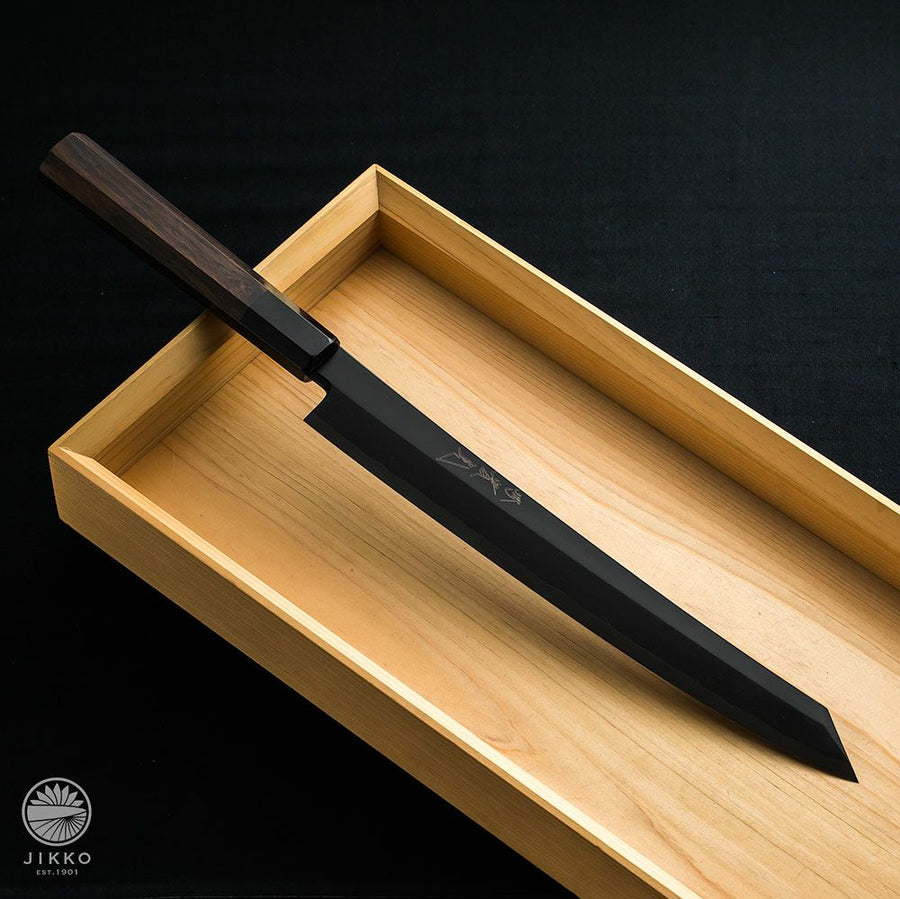
The when written in Japanese we chose the KANJI “至光” for this series. The kanji was chosen from 2 terms; “至高 (Shiko)” that means supreme, and our company name, “實光 (JIKKO)”. The shape used for this knife’s blade is unique to JIKKO. The picture above is a white carbon #2 steel blade sashimi Kiritsuke knife. The SHIKO series is featured with different handles, depending on the steel material being used.
On the Kiritsuke sashimi knife above, ebony wood with white water buffalo horn ferrule. These knives are just once-in-a-lifetime knife, and the handle of each knife adds the luxurious feel to the knife. SHIKO series, that has JIKKO original shaped blades on them, has slightly curved blade, and you can choose different blade tip customization like Kiritsuke and Saki Maru style.

【GINZA Blue】Kiritsuke Deba knife
Deba is a type of knife that originated from Sakai. This filleting knife is also excellent for cutting non-fish ingredients like Kabocha pumpkins. The picture above is Ginza series’ Deba knife with Blue Carbon #2 steel for the steel material, and is one of the popular Deba knives that we carry at JIKKO. The black-coating finish that is unique to JIKKO cutlery, the Kiritsuke customization that shines black, and the extraordinary cutting edge of blue carbon steel, all gives a special presence to this knife. The knife well surly catch everyone’s eyes, especially when you prepare your dish on front of the customer on kitchen countertops. When you need to sharpen the GINZA knives, the black coating on the shinogi line will come off eventually, and the original steel will start to show up, and gives a new two-tone appearance to the knife which you can further enjoy this one-of-a-kind knife.
The High-End Knives of a Lifetime, From Japan to the World
Japan’s high-end knives are not mere cooking tools; it is a craftwork imbued with long history and craftsmanship. By fusing forging techniques passed down for over 400 years with modern processing technologies and latest materials, the knives have “sharpness” and the “beauty” that chefs and cooking enthusiasts worldwide praise.
An “good” knife, with right care and maintenance, can be used for over decades. The joy of unchanging sharpness, knife fitting on the hand, and the presence that enriches your cooking hours. These are what makes the knife “lifetime tool”.
JIKKO Cutlery’s knives are chosen by many in Japan, and globally, by many professional chefs and cooking enthusiasts. The knife, crafted with preserved traditions and new innovations, will surely change your daily cooking experience to something special.
Please find a once-in-a-lifetime knife from JIKKO’s high quality knives.